 Cointracking
 uses FIFO to trace withdrawals through its Source of Funds report
Cointracking uses its Source of Funds report to trace a selected crypto withdrawal through the transaction history imported into your account. The trace applies first in, first out (FIFO) and groups the withdrawal’s origins into source categories. A PDF presents the explanation, and a companion comma-separated values (CSV) file carries supporting data. Pro, Expert, and Unlimited include the feature without a separate report charge. Its usefulness rests on the records behind the withdrawal, including earlier trades, transfers, and income. Missing history remains visible as a gap, and the receiving institution decides whether the report and accompanying documents meet its requirements.
Which withdrawal does the Source of Funds report explain?
Each report explains the recorded origins of the specific withdrawal selected in the account. Its scope follows the transactions that contributed to that outgoing amount, potentially crossing earlier trades, transfers, and income events. Portfolio analysis describes holdings and performance across the account. The withdrawal report follows the history behind one outgoing amount, showing the contributing sources and their shares.
FIFO connects the withdrawal to earlier records
The tracing rule
The Source of Funds trace uses FIFO to follow a withdrawal back through its recorded history. Earlier available funds take priority in that allocation. The path can include exchanges between assets and transfers between locations before reaching an originating deposit or income event. An incoming exchange deposit may therefore sit within the path, with earlier records explaining where those funds originated.
Tax calculation settings
Tax calculations separately support multiple methods and a depot separation setting, which treats exchanges and wallets independently for gain calculations. Those controls describe tax accounting. The origin report’s FIFO trace answers where the funds behind a withdrawal came from.
Source categories preserve different kinds of origin
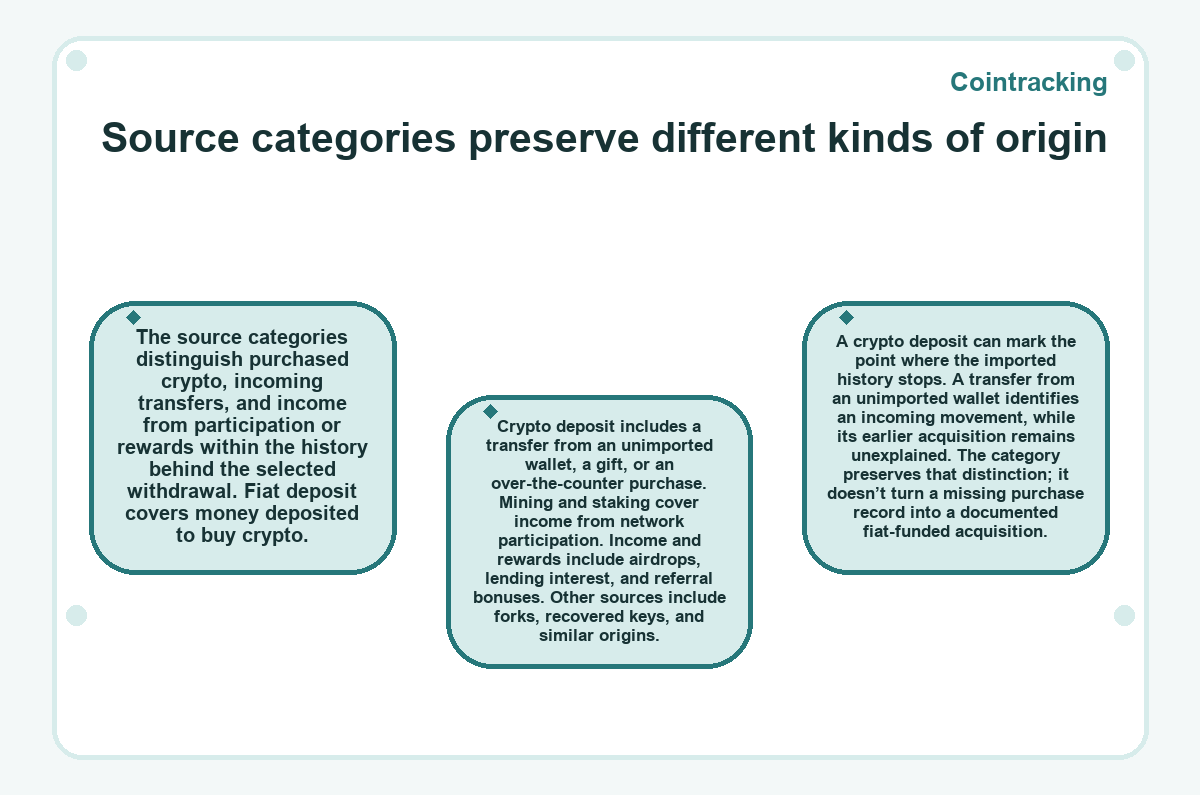
The source categories distinguish purchased crypto, incoming transfers, and income from participation or rewards within the history behind the selected withdrawal.
- Fiat deposit covers money deposited to buy crypto.
- Crypto deposit includes a transfer from an unimported wallet, a gift, or an over-the-counter purchase.
- Mining and staking cover income from network participation.
- Income and rewards include airdrops, lending interest, and referral bonuses.
- Other sources include forks, recovered keys, and similar origins.
A crypto deposit can mark the point where the imported history stops. A transfer from an unimported wallet identifies an incoming movement, while its earlier acquisition remains unexplained. The category preserves that distinction; it doesn’t turn a missing purchase record into a documented fiat-funded acquisition.
Earlier transaction records determine how far the trace reaches
The depth of an origin trace follows the available transaction history, including records from long before the withdrawal. Purchases, deposits, withdrawals, and income can all contribute to the path. Importing only recent exchange activity can leave the earlier acquisition outside that history.
Some exchange APIs omit older periods or particular transaction types. CSV imports can supply historical records that the API didn’t deliver. Where an importer offers Complete Import, that option can retrieve a fuller history. Its availability belongs to the particular importer, so a standard API connection alone doesn’t establish complete coverage.
Wallet records connect movements between self-custody and exchange accounts. Supported blockchain imports retrieve history from a public address. Including the relevant wallet history gives the trace earlier records to follow, while an exchange-only history can leave an incoming wallet transfer as the earliest recorded point.
Saved exports remain relevant when an exchange has closed. Historical importers can process records from supported defunct exchanges, and retained CSV files can preserve transactions that a current account login no longer supplies. An archive’s coverage determines which periods it can explain.
The File Converter provides another route for existing CSV or Excel records on Expert and Unlimited. It interprets columns and produces an importable file. Review the mapped dates, assets, amounts, and transaction types before importing, because AI-assisted conversion can be incomplete or inaccurate.
Account checks reveal missing and incorrect records
Calculated balances
Negative crypto balances can indicate missing history. Compare Balance by Exchange with actual holdings before relying on the transaction records behind a withdrawal trace.
Duplicate records
Duplicate trades or transfers can inflate recorded funds. The Trade List’s Full View and Advanced Search help isolate the affected asset and exchange. The Imported column identifies the entry’s import source, which helps distinguish repeated records from separate transactions.
Incorrect wallet entries
Blockchain imports can contain wrong transaction directions, duplicate entries, or missing internal transactions. Compare questionable entries with the underlying wallet history and correct the affected records before producing the document.
A withdrawal with a partly unexplained earlier origin
Consider a hypothetical history for one crypto asset: an earlier purchase of 1.32 units funded by a documented fiat deposit, followed by a 0.47-unit deposit from a wallet whose earlier history wasn’t imported. A later withdrawal contains 1.62 units. These are the only available acquisitions for that asset, with no intervening trades, fees, or withdrawals.
FIFO allocates the earlier 1.32 units to the withdrawal first. The remaining amount is 1.62 minus 1.32, or 0.30 units, which comes from the later crypto deposit. That leaves 0.17 units of the deposit outside this withdrawal.
The trace connects 1.32 withdrawn units to the recorded fiat-funded purchase. For the other 0.30 units, it reaches the wallet transfer, with the earlier origin still missing. A finished PDF can therefore contain a clearly identified gap. Adding genuine earlier wallet records could extend that part of the trace.
Does the Source of Funds report replace a tax report?
The Source of Funds report doesn’t replace the tax report that calculates gains, losses, and income for a reporting period. An origin trace explains the funds behind a selected withdrawal. Tax reporting applies country and calculation settings to the relevant activity. An institution may request both documents, together with evidence for the fiat payments. Each answers a different part of the enquiry, so a completed withdrawal trace doesn’t establish that a tax return is complete.
The PDF and CSV serve different review tasks
The PDF presents the withdrawal’s origin trail, while the companion CSV supplies transaction data that an accountant can inspect alongside that explanation.
The Source of Funds PDF is generated locally in the browser. That describes the report-rendering step; the account still contains the imported history used for the trace. Downloaded files can disclose transaction amounts, dates, and contributing sources to their recipients. Share the requested files through the receiving institution’s agreed submission channel, keeping the PDF and supporting data together when both are requested.
Plan access covers repeat reports
Pro, Expert, and Unlimited include Source of Funds with no per-report fee or usage cap. Free and Starter accounts show an upgrade prompt. This entitlement concerns the withdrawal-report feature; other account limits and optional tools have their own plan conditions.
File Converter requires Expert or Unlimited. Pro includes origin tracing, with AI-assisted spreadsheet conversion remaining outside that tier.
Import methods remain visible in the evidence
The report identifies whether a transaction came from a blockchain import, an exchange import, or manual entry. It also grades sources by evidentiary value.
An origin category and an import method describe different attributes. A staking reward describes how assets arose; its import method describes how the account obtained that transaction record. The report carries both kinds of information so the receiving reviewer can assess the history and its supporting records.
Fiat documents support the submission
For crypto bought with fiat, supporting documents explain where the purchase money came from. The withdrawal report accompanies those records, along with any requested tax reports. A short cover letter can explain the circumstances and connect the submitted documents to the institution’s enquiry.
Final acceptance rests with the receiving reviewer. A trace that exposes an unresolved incoming deposit can require earlier wallet records or further supporting documents. The next requirement therefore changes with the unexplained part of the history and the institution’s review, even when the PDF itself is complete.
Cointracking FAQs
Where can I find the Source of Funds Report control for a withdrawal?
The Report control is beside the relevant withdrawal under Analysis, then Transactions, then Source of Funds. It applies to that withdrawal’s origin trace. Access to the feature requires Pro, Expert, or Unlimited; Free and Starter accounts receive an upgrade prompt.
How quickly does the Source of Funds PDF generate after import?
The PDF generates in seconds once the transaction history is imported. That timing concerns tracing and rendering the document. Obtaining missing exports, correcting account records, or resolving questions from the receiving institution involves separate work, so the generation time doesn’t describe the duration of the entire review.
Can a matching Live Balance confirm a withdrawal’s full provenance?
A matching Live Balance doesn’t confirm a withdrawal’s full provenance. Live Balance provides a quick comparison with actual holdings; imported transactions drive the account’s calculated balances and reports. A current quantity can match even when earlier acquisition records remain missing, so the origin trace needs its own historical records.
Does API preparation for an origin report require trading permissions?
Exchange API imports use read-only permissions to retrieve transaction history for the origin report. Keep the specific reading permissions required by the importer, and disable trading and withdrawal permissions. API access supplies records without moving assets into the reporting account. CSV imports provide a separate way to supply exported history.
Which wallet credentials are needed for blockchain-based origin tracing?
A supported blockchain import uses the public wallet address to retrieve on-chain history. It doesn’t need a seed phrase or private key. The address supplies records for the withdrawal trace, and importing it doesn’t establish complete coverage by itself: missing internal transactions or other import errors can still require correction.
Can manual entries fill a missing segment of the withdrawal history?
Manual entries can supply transactions missing from an automated import or saved export. The origin report identifies manual records by their import method, preserving how the account obtained them. Enter the actual transaction details and retain supporting records; filling an account gap doesn’t independently corroborate the earlier acquisition.
Why do small balance differences matter when preparing an origin report?
Small coin discrepancies can come from unrecorded fees, which leave the transaction history inconsistent with actual holdings. Missing fees can be added using the [OUT] OTHER FEE transaction type or included in the corresponding trade. Establish the cause of the difference before changing a record, since other import problems can also affect balances.
Updated on